Experiments / ACME burners
Supports fire safety
E-FIELD Flames
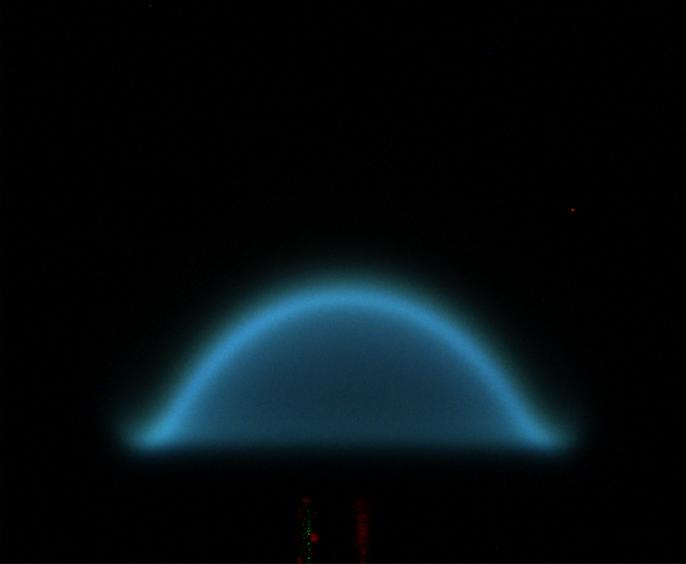
Applied a high-voltage field to small gas flames; the resulting ion wind reshapes a flame much as weak gravity would.
What burned
Gas
Methane and ethylene
Where
On the space station
In orbit, where everything is weightless
How much data
21 test days
NASA's table lists days, each with several flames
What they changed between tests
- field polarity and strength
- fuel
- fuel dilution
- burner type
What it found
NASA states plainly that this work was not done for a space application - its value to fire safety is as a stand-in for partial gravity.
NASA's words
“The E-FIELD Flames research is not being conducted to serve any space applications” PSI record
Summarized by the SI. Each summary is tied to a quotation that the build checks against NASA's text. A matching quote is not a scientific review.
What it helps with
Stopping a fire from starting
Which materials burn, and in what air
Not an aim
Noticing a fire early
What smoke looks like to a detector
Not an aim
Putting a fire out
What makes a flame go out
Touches on it
For researchers: NASA's full recordThe conditions tested, every row of the table, NASA's description, publications and hardware
Shared hardware: Six gas-flame experiments shared one modular set of burners and diagnostics. Experiments that shared hardware share its limits, so their results can be compared directly.
Why it counts as fire-safety research
“Partial gravity was mimicked in ACME's Electric-Field Effects on Laminar Diffusion Flames (E-FIELD Flames) experiment through the effect of the electric field on the ions that naturally occur in flames.” NASA challenge statement
NASA's words behind each rating
- Prevention0 of 3
Not an aim of this investigation.
- Detection0 of 3
Not an aim of this investigation.
- Suppression1 of 3
“enabling precise manipulation of flame stability, soot behavior, and combustion dynamics through ion-driven convection”
Conditions covered
- Oxygen in the atmosphere
- not reported
- airMoon
- not in the PSI table
- Pressure
- not reported
- Moonsea level
- not in the PSI table
- Flow speed
- not reported
- not in the PSI table
- Itemized rows
- 21
- 21 test days
Fuels and materials
methane (11), ethylene (10)
Measurements named in the PSI record
- Flame imaging
- Chemiluminescence
- Soot measurement
- Ion current
How the tests differ, and how they are the same
Worked out from the 21 rows of the PSI table. A variable that is not listed was not reported, which is different from being held fixed.
Changed from test to test
- Fuel or material
- 2 different values
- Fuel fraction
- 25% to 100%
- Geometry
- 2 different values
- Flames ignited
- 8 to 15
The same in every test
- Fuel phase
- gas
- Fuel diluent
- N2
Rows from the PSI table
Click a row for the source of every value. Filter and export
| Record | Type | Fuel or material | Shape | Oxygen | Pressure | Flow, cm/s | Outcome | Date |
|---|---|---|---|---|---|---|---|---|
| Day 18073 | Test day | methane | coflow jet | not reported | not reported | 2018-03-14 | ||
| Day 18078 | Test day | methane | coflow jet | not reported | not reported | 2018-03-19 | ||
| Day 18080 | Test day | methane | coflow jet | not reported | not reported | 2018-03-21 | ||
| Day 18087 | Test day | ethylene | coflow jet | not reported | not reported | 2018-03-28 | ||
| Day 18092 | Test day | ethylene | coflow jet | not reported | not reported | 2018-04-02 | ||
| Day 18095 | Test day | ethylene | coflow jet | not reported | not reported | 2018-04-05 | ||
| Day 18102 | Test day | methane | coflow jet | not reported | not reported | 2018-04-12 | ||
| Day 18106 | Test day | methane | coflow jet | not reported | not reported | 2018-04-16 | ||
| Day 18113 | Test day | methane | coflow jet | not reported | not reported | 2018-04-23 | ||
| Day 18130 | Test day | methane | coflow jet | not reported | not reported | 2018-05-10 | ||
| Day 18137 | Test day | ethylene | coflow jet | not reported | not reported | 2018-05-17 | ||
| Day 18269 | Test day | methane | gas jet | not reported | not reported | 2018-09-26 | ||
| Day 18274 | Test day | ethylene | gas jet | not reported | not reported | 2018-10-01 | ||
| Day 18282 | Test day | methane | gas jet | not reported | not reported | 2018-10-09 | ||
| Day 18285 | Test day | ethylene | gas jet | not reported | not reported | 2018-10-12 | ||
| Day 18290 | Test day | ethylene | gas jet | not reported | not reported | 2018-10-17 | ||
| Day 18298 | Test day | methane | gas jet | not reported | not reported | 2018-10-25 | ||
| Day 18302 | Test day | ethylene | gas jet | not reported | not reported | 2018-10-29 | ||
| Day 18312 | Test day | methane | gas jet | not reported | not reported | 2018-11-08 | ||
| Day 18319 | Test day | ethylene | gas jet | not reported | not reported | 2018-11-15 | ||
| Day 18319 | Test day | ethylene | gas jet | not reported | not reported | 2018-11-15 |
How the table was read, and what was repaired
E-FIELD Flames - test days
PSI-22_Experimental table_ACME E-FIELD Flames.csv
32 rows in the file, 21 kept as records. Session summary - one row per test day. Oxygen and pressure are not listed in the PSI table.
- Test day is formatted YYDDD where YY identifies year and DDD identifies day of year (GMT).
- Mesh polarity refers to the polarity of the high-voltage power supply and the copper electrode relative to the burner.
- Fuel Conc. (diluted with nitrogen on a volume basis) was varied between tests, but typically matched the bottle. The list only accounts for flames ignited.
- Flames Ignited is the number ignited on that day (neglecting the day change on ISS).
sha256 69090c357b83ae38d161d29001d1d32b40fd77b13324ca6585ee990cdceef524 · fetched 2026-11-11
Repairs and warnings
- 11 continuation row(s) were folded into the test day they belong to (they list further values of Fuel Conc).
NASA's description
Objectives
The objective of this investigation is to better understand the relationship between electric field voltage and chemi-ion current, analyze the dynamic response of flames to electric field changes, evaluate soot formation, and characterize stabilized near-limit lifted flames.
Approach
The E-FIELD flames experiment investigates how electric fields influence the behavior of laminar diffusion flames in microgravity. This unique environment is ideal for isolating electric field effects from buoyancy forces. The experiment is conducted with gas-fueled flames, both with and without a coflow of air. In the former case, the tests are conducted using the same coflow burner used by the Coflow Laminar Diffusion (CLD) Flame experiment. An electric field is generated by creating a high voltage (up to 10 kV) differential between the burner and a flat circular mesh suspended above (i.e., downstream of) the burner. Measurements, as a function of the field strength and fuel, are taken of the ion current through the flame and the flame’s response time to electric forcing. The gas-jet burner is used to create a small, focused flame for detailed ion-driven convection studies while the coflow burner surrounds the fuel jet with a weak synthetic air flow to enable flame stability and soot behavior analysis. A high-voltage copper mesh electrode positioned above the burner tip generated an electric field with controlled polarity and strength. The electric field interacts with ions generated through chemi-ionization during combustion, driving ion-driving convection and influencing flame behavior. Methane and ethylene were used as fuels and diluted with nitrogen to control flame strength. Dilution levels were varied to explore a range of combustion dynamics, from highly stable to near-extinction flames. Voltage-current curves were recorded to assess the relationship between electric field strength and chemi-ion current, revealing ion-driven convection effects. High-resolution cameras captured flame shape, luminosity, and soot distribution. Spectral imaging with filters measures chemiluminescent emissions and soot volume fraction. There were thermopile detectors to measure flame radiant emissions. All experiments were conducted in the combustion integrated rack (CIR). Tests were administered with Glenn Research Center (GRC) directing astronaut actions. Parameters such as fuel flow rate, coflow velocity, and field polarity are were varied to isolate specific effects on ion production, flame stability, and soot behavior.
Hypothesis
The application of electric fields in microgravity environments will significantly influence laminar diffusion flames by enabling precise manipulation of flame stability, soot behavior, and combustion dynamics through ion-driven convection and chemi-ionization processes.
Research impacts and Earth benefits
The E-FIELD Flames research is not being conducted to serve any space applications, but it is possible that its findings could aid the development of future space-based combustion devices (e.g., for solid waste processing). The use of electric fields to control flames can reduce the production of harmful pollutants in practical terrestrial combustion. The combustion of fossil fuel is the primary human source of greenhouse gas and acid rain and furthermore creates soot, which can be beneficial but is also a health hazard. Combustion using electrical fields may also allow for more efficient combustion, reducing fuel consumption in addition to unwanted emissions.
Publications
25 listed in PSI, 22 with a DOI.
- Ion Current and Flame Changes with Electric Fields in MicrogravityYC Chien, J Tinajero, D Stocker, U Hegde, D Dunn-Rankin
- Electric Field Induced Changes of a Diffusion Flame and Heat Transfer near an Impinging SurfaceChien Yu-Chien, Dunn-Rankin Derek
- Electrical Aspects of Impinging FlamesY-C Chien
- The Influence of Electric Field Power Systems on Flame BehaviorK Yamashita, Y-C Chien, S Karnani, D Dunn-Rankin
- Ionization and chemiluminescence during the progressive aeration of methane flamesWeinberg Felix, Carleton Fred
- Modelling electric field driven convection in small combustion plasmas and surrounding gasesPapac M. J., Dunn-Rankin D.
Show the other 19
- Canceling buoyancy of gaseous fuel flames in a gravitational environment using an ion-driven wind.Papac MJ, Dunn-Rankin D.
- Detailed characterization of DC electric field effects on small non-premixed flamesKarnani Sunny, Dunn-Rankin Derek
- Microgravity burner-generated spherical diffusion flames: experiment and computation. Currently at Department of Mechanical and Aerospace Engineering, Case Western Reserve University, Cleveland, OH 44106.Tse Stephen D, Zhu Delin, Sung Chih-Jen, Ju Yiguang, Law Chung K
- PLIF and chemiluminescence in a small laminar coflow methane-air diffusion flame at elevated pressuresEscofet-Martin David, Chien Yu-Chien, Dunn-Rankin Derek
- Ion current and carbon monoxide release from an impinging methane/air coflow flame in an electric fieldChien Yu-Chien, Escofet-Martin David, Dunn-Rankin Derek
- Non-premixed axisymmetric flames driven by ion currentsTinajero Jesse, Dunn-Rankin Derek
- Impinging nonpremixed coflow methane–air flames with unity Lewis numberM. Sauer Vinicius, Dunn-Rankin Derek
- Characterizing I-V Curves for Non-Premixed Methane Flames Stabilized on Different Burner ConfigurationsTinajero Jesse, Bernard Guillaume, Autef Louise, Dunn-Rankin Derek
- CO emission from an impinging non-premixed flameChien Yu-Chien, Escofet-Martin David, Dunn-Rankin Derek
- Electrical aspects of flame quenchingWeinberg F.J., Dunn-Rankin D., Carleton F.B., Karnani S., Markides C., Zhai M.
- Behavior of a small diffusion flame as an electrically active component in a high-voltage circuitBorgatelli Francesco, Dunn-Rankin Derek
- Numerical prediction of ion current from a small methane jet flameYamashita Kiyotaka, Karnani Sunny, Dunn-Rankin Derek
- Electric field-controlled mesoscale burnersWeinberg Felix, Carleton Fred, Dunn-Rankin Derek
- Numerical simulation of a tubular ion-driven wind generatorRickard Matthew, Dunn-Rankin Derek
- Using large electric fields to control transport in microgravity.Dunn-Rankin D, Weinberg FJ.
- Maximizing ion-driven gas flowsRickard Matthew, Dunn-Rankin Derek, Weinberg Felix, Carleton Fred
- Inducing gas flow and swirl in tubes using ionic wind from corona dischargesWeinberg Felix, Carleton Fred, Kara Dhiren, Xavier Agatha, Dunn-Rankin Derek, Rickard Matthew
- Modeling of Elevated Pressure Diffusion Flames with Water AdditionChien Yu-Chien, Girodon Hugo, Esquivias Rodriguez Brandon
- Electric-field effects on methane coflow flames aboard the international space station (ISS): ACME E-FIELD flamesChien Yu-Chien, Stocker Dennis P., Hegde Uday G., Dunn-Rankin Derek
Hardware and raw data
950 GB of raw data on PSI. FlameLens reads the experimental table, not the raw video or sensor files.
Linked investigations
On Earth
Cleaner combustion: Electric fields as a way to cut pollutants from practical burners.
“The use of electric fields to control flames can reduce the production of harmful pollutants in practical terrestrial combustion.”