Experiments / Smoke diagnostics
SAMEA spacecraft fire-safety study
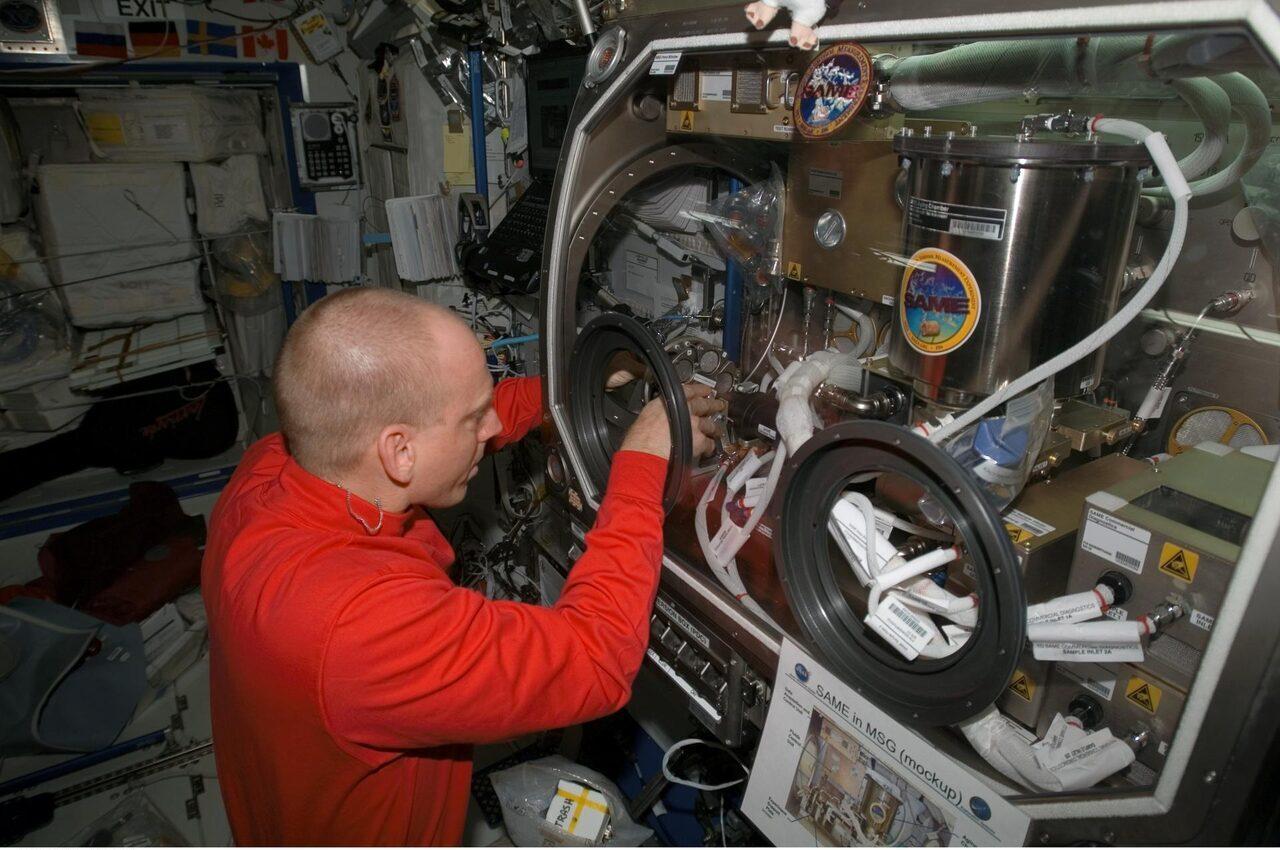
Smoke and Aerosol Measurement Experiment
Heated common spacecraft materials until they smoked and measured the particles, to learn what a smoke detector must sense in space.
What burned
Solid materials
Wire insulation, silicone, cotton wick and 1 more
Where
On the space station
In orbit, where everything is weightless
How much data
8 table rows
NASA's table groups the tests, so one row can hold several
What they changed between tests
- sample material
- airflow
- heating rate
- smoke aging time
What it found
- 1 of 2
Without buoyancy, smoke particles are expected to grow larger than on Earth - which changes what a detector sees.
NASA's words
“will lead to larger particles compared to those produced in 1g” PSI record
- 2 of 2
The data are meant to judge whether today's detectors are sensitive enough to low-gravity smoke.
NASA's words
“SAME will provide quantitative data on the sensitivity of these detectors to reduced gravity smokes” PSI record
Summarized by the SI. Each summary is tied to a quotation that the build checks against NASA's text. A matching quote is not a scientific review.
What it helps with
Stopping a fire from starting
Which materials burn, and in what air
Not an aim
Noticing a fire early
What smoke looks like to a detector
A main aim
Putting a fire out
What makes a flame go out
Not an aim
For researchers: NASA's full recordThe conditions tested, every row of the table, NASA's description, publications and hardware
Shared hardware: Particle counters and smoke detectors; one of the instruments was first proven in a dust test. Experiments that shared hardware share its limits, so their results can be compared directly.
Why it counts as fire-safety research
“Fire detection was tested in microgravity through the Smoke and Aerosol Measurement Experiment studies (SAME and SAME-R).” NASA challenge statement
NASA's words behind each rating
- Prevention0 of 3
Not an aim of this investigation.
- Detection3 of 3
“The SAME experiment will provide technology for an advanced fire detector for future spacecraft that will be used for long duration missions.”
- Suppression0 of 3
Not an aim of this investigation.
Conditions covered
- Oxygen in the atmosphere
- not reported
- airMoon
- not in the PSI table
- Pressure
- not reported
- Moonsea level
- not in the PSI table
- Flow speed
- 5 to 10 cm/s
- Itemized rows
- 8
- 4 tests, 4 envelopes
Fuels and materials
Teflon (4), Kapton (1), Silicone (1), Lamp wick (1), Dibutyl phthalate (1)
Measurements named in the PSI record
- Flame imaging
- Particle sizing
- Aerosol counters
- Mass loss
How the tests differ, and how they are the same
Worked out from the 8 rows of the PSI table. A variable that is not listed was not reported, which is different from being held fixed.
Changed from test to test
- Flow speed
- 5 cm/s to 10 cm/s
- Fuel or material
- 5 different values
- Smoke aging time
- 60 s to 1,200 s
- Mass loss rate
- 1 mg/min to 2 mg/min
The same in every test
- Fuel phase
- solid
- Geometry
- heated sample (smoke source)
Rows from the PSI table
Click a row for the source of every value. Filter and export
| Record | Type | Fuel or material | Shape | Oxygen | Pressure | Flow, cm/s | Outcome | Date |
|---|---|---|---|---|---|---|---|---|
| Sample 1 | Test | Teflon | heated sample (smoke source) | not reported | not reported | 5 | ||
| Sample 2 | Test | Teflon | heated sample (smoke source) | not reported | not reported | 5 | ||
| Sample 3 | Test | Teflon | heated sample (smoke source) | not reported | not reported | 5 | ||
| Sample 4 | Test | Teflon | heated sample (smoke source) | not reported | not reported | 10 | ||
| Sample 5 | Envelope | Kapton | heated sample (smoke source) | not reported | not reported | 5 to 10 | ||
| Sample 6 | Envelope | Silicone | heated sample (smoke source) | not reported | not reported | 5 to 10 | ||
| Sample 7 | Envelope | Lamp wick | heated sample (smoke source) | not reported | not reported | 5 to 10 | ||
| Sample 8 | Envelope | Dibutyl phthalate | heated sample (smoke source) | not reported | not reported | 5 to 10 |
How the table was read, and what was repaired
SAME - smoke tests
PSI-102_Experimental table_SAME.csv
8 rows in the file, 8 kept as records. Smoke-generation tests - samples are heated to produce smoke; there is no flame, so oxygen and pressure are not test variables.
sha256 268d1e121d2f211b124407dd32b9475617bd269ede2c2d1749441da3e949a2af · fetched 2026-11-11
Repairs and warnings
- 4 row(s) say 'same conditions as' other rows; they are kept as envelopes listing those conditions.
NASA's description
Objectives
One of the major goals of this investigation was to quantify the sizes that the liquid smoke particulate achieves in low gravity and to relate the droplet size distribution to the smoke generation and smoke transport conditions in the experiment. A numerical code was to be developed to predict the smoke droplet growth as a function of the fuel pyrolysis rate, the thermodynamic properties of the pyrolysis vapor, and the flow environment.
Approach
The crew installed the near field hardware in the Glovebox, attached the Far Field Box to the Glovebox, and positioned the video cameras. The operator then ran the self diagnostic procedures on the two smoke detectors and activated the video cameras, turned on the igniter for a predefined period of time (15 to 60 seconds), and initiated the thermophoretic soot samplers to sample the smoke. The actual duration of each combustion event was typically 2 minutes. After flight, the particulate collected on the thermophoretic probes were analyzed using a Transmission Electron microscope (TEM) to determine primary and aggregate particle dimensions. The remains of the samples were weighed to determine their mass loss. The digital data was transcribed from the video record and analyzed to determine the response of the detectors. Once the flight mass loss rates were determined, 1-g operation conditions to produce the same loss were determined.The measurements were made using smoke generated by overheated spacecraft materials where variables such as the sample temperature, flow field, and particle aging time were more rigorously controlled.
Hypothesis
The three hypotheses that motivated this investigation: In a μg environment, with the absence of the strong buoyancy-induced flows, smoke particle growth from a pyrolyzing/smoldering source, as a result of nucleation, condensation, and coagulation, will lead to larger particles compared to those produced in 1g. The formation of the larger particles is favored by the expected higher vapor concentration and smoke residence times near the source due to the reduced velocities and mixing at μg conditions. In particular, it is hypothesized that liquid aerosol smokes produced in microgravity will exhibit substantially larger droplet sizes than under the same conditions in normal gravity (with a corresponding decrease in the particle number density for the same mass of smoke). The change in the size distribution and number density will, in turn, affect the response of the smoke detectors and possibly result in some detectors not producing an alarm when exposed to this smoke.
Research impacts and Earth benefits
The SAME experiment will provide technology for an advanced fire detector for future spacecraft that will be used for long duration missions. SAME will provide quantitative data on the sensitivity of these detectors to reduced gravity smokes that will allow evaluation of the adequacy of these existing technologies using relevant data. The current Fire Prevention, Detection, and Suppression (FPDS) program plan allows for the re-evaluation of future sensor technology, to allow new technology and capability to be utilized. The results from SAME are needed to provide the reduced gravity baseline data against which future detection technology developments can be evaluated.The smoke detectors developed from the results of SAME can also be useful in other extreme environments on Earth, such as submarines or underwater laboratories. Accurate detection of smoke in these environments can save lives.
Publications
16 listed in PSI, 10 with a DOI.
- Measurement of Smoke Particle Size under Low-Gravity ConditionsUrban David L., Ruff Gary A., Mulholland George W., Cleary Thomas G., Yang Jiann C., Yuan Zengguang
- Properties of Smoke from Overheated Spacecraft Materials in Low-GravityDL Urban, GA Ruff, W Sheredy, T Cleary, J Yang, G Mulholland, Z Yuan
- Smoke Particle Sizes in Low-Gravity and Implications for Spacecraft Smoke Detector DesignUrban David L., Ruff Gary A., Mulholland George W., Cleary Thomas G., Yang Jiann C., Yuan Zengguang, Bryg Victoria
- Spacecraft Fire Detection: Smoke Properties and Transport in Low-GravityUrban David, Ruff Gary, Brooker John, Cleary Thomas, Yang Jiann, Mulholland George, Yuan Zeng-Guang
- ISS Destiny Laboratory Smoke Detection ModelBrooker John E., Urban David L., Ruff Gary A.
- Smoke: Characterization of Smoke Particulate for Spacecraft Fire Detection, Seventh International Microgravity Combustion WorkshopDL Urban, GW Mulholland, J Yang, TG Cleary, and ZG Yuan
Show the other 10
- Smoke: Characterization of Smoke Particulate for Spacecraft Fire DetectionDL Urban, GW Mulholland, J Yang, TG Cleary, ZG Yuan
- Characterization of Nuisance Particulates in the ISS: Space Smoke Aerosols and Lunar Dust AbatementBryg VM, Yuan Z-G, Urban DL, Ruff G, Mulholland G, Agui J
- Combustion Research on the International Space StationMalley, WA Sheredy, DP Stocker
- Detection of Smoke from Microgravity FiresDL Urban, D Griffin, G Ruff, T Cleary, J Yang, G Mulholland, ZG Yuan
- A Research Plan for Fire Prevention, Detection and Suppression in Crewed Exploration SystemsRuff Gary, Urban David, King Merrill
- Pyrolysis Smoke Generated Under Low-Gravity ConditionsMulholland George W., Meyer Marit, Urban David L., Ruff Gary A., Yuan Zeng-guang, Bryg Victoria, Cleary Thomas, Yang Jiann
- Smoke Characterization and Feasibility of the Moment Method for Spacecraft Fire DetectionMeyer Marit E., Mulholland George W., Bryg Victoria, Urban David L., Yuan Zeng-Guang, Ruff Gary A., Cleary Thomas, Yang Jiann
- Evaluation of spacecraft smoke detector performance in the low-gravity environmentMeyer Marit E., Urban David L., Mulholland George W., Bryg Victoria, Yuan Zeng-Guang, Ruff Gary A., Cleary Thomas, Yang Jiann
- The Microgravity Science Glovebox (MSG), a Resource for Gravity-Dependent Phenomena Research on the International Space Station (ISS)Spivey Reggie, Jeter Linda, Vonk Chris
- AN OVERVIEW OF THE MICROGRAVITY SCIENCE GLOVEBOX (MSG) FACILITY, AND THE GRAVITY-DEPENDENT PHENOMENARESEARCH PERFORMED IN THE MSG ON THE INTERNATIONAL SPACE STATION (ISS)Reggie Spivey, Kenneth B. Morris
Hardware and raw data
658 MB of raw data on PSI: reports 1, metadata 1, analyzed data 63, presentations 6, reference data 3, science documents 2, engineering documents 28. FlameLens reads the experimental table, not the raw video or sensor files.
Linked investigations
- SAME-R
- SAME smoke modelling re-analysed this data
On Earth
Smoke detection: Particle-size data for early, pre-flame smoke supports better smoke detector design.
“provide technology for an advanced fire detector”